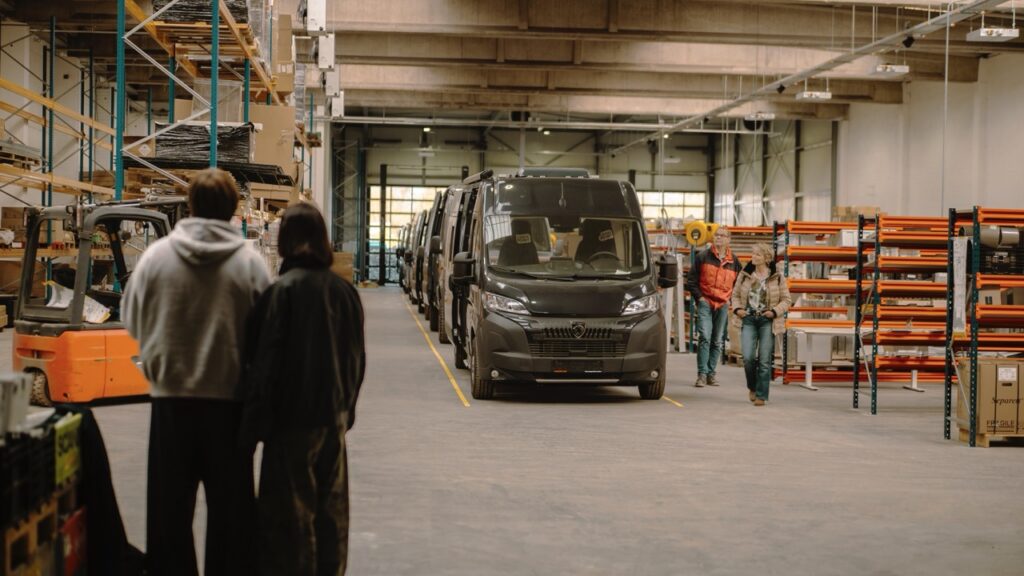
Until recently, electric campers were mainly compact vans with a pop-up roof. Ideal as a daily car and wonderful for weekend getaways. If you want a bit more camper and a bit less car, you quickly find yourself looking for something more spacious. And nowadays, that can also be fully electric. The Peugeot e-Boxer makes that possible, and the VAN-Jorn CHARGE shows just how mature an electric campervan has become. With a 110 kWh battery pack, you can drive approximately 350 kilometers in practice.
In short, electric camping is not a futuristic idea. You can do it today.
350 kilometers, isn’t that a bit low?
It’s actually not that bad. Most camper owners don’t drive longer distances in a single day. With a few short charging stops, you’re back on the road in no time. The e-Boxer charges at up to 150 kW. While you eat a sandwich or stretch your legs, there’s already enough power for over three hours of driving.
Electric driving also fits surprisingly well with the rhythm of camping. Taking it a bit slower, stopping more often along the way, and enjoying the silence.
And what about those charging stations?
Traveling through Europe with an electric campervan gets easier every year. More and more countries have their charging networks in excellent order. At the absolute top are Norway, Luxembourg, Denmark, the Netherlands, Belgium, Germany, France, Sweden, Iceland, and Switzerland. There, you will find reliable AC and fast-charging stations almost everywhere along highways, in cities, and even in remote areas.
Even in countries that were lagging behind a few years ago, things are moving fast now. Austria, the United Kingdom, Italy, Spain, Finland, Portugal, Ireland, and many Central European countries are significantly expanding their networks. Especially along major transit routes and at campsites, new charging points are popping up like mushrooms.
With a bit of smart planning, you can get practically anywhere.
But aren’t electric campers too heavy?
That question comes up often. Batteries have weight, and that adds up. Fortunately, European regulations are making this easier. It has been decided that fully electric vehicles up to 4,250 kg can be driven with a standard Category B driver’s license. All European countries must implement this rule in the coming years.
Those who want to stay ahead of the curve can already choose a van prepared for 4,250 kg. With a temporary administrative restriction, it is set at 3,500 kg. This allows you to drive in any country with a Category B license. As soon as the European rule is implemented everywhere, the permitted weight can be increased again.
If you want to know exactly how this works, read our separate blog about the weight of electric campers.
Which electric campers are already available for purchase?
In the compact segment, there are now several great options. Think of brands like Outbase, Tonke, and Ventje. Each one is a smart, lightweight, and creative camper that shows how versatile electric driving can be.
In the larger campervan segment, things are different. There, the VAN-Jorn CHARGE is currently the only fully electric-built campervan in Europe. This is because the base van, the Peugeot e-Boxer, has a unique version specifically developed for camper manufacturers.
Why the VAN-Jorn CHARGE is special
The CHARGE is built on a special camper version of the Peugeot e-Boxer. This variant is identical to the e-Ducato, has no speed limiter, a faster DC charger up to 22 kW, and offers possibilities to use the traction battery for the living area. This base makes electric camping practical and reliable.
On top of that comes the lightweight, modular interior. This ensures ease of use, a low total weight, and a practically designed living space.
What you’ll find as standard in the CHARGE
- A lithium living system that works together with the traction battery
- Infrared floor heating
- A removable induction kitchen
- All-round insulation
- An external power socket
- Tinted taillights and a mustard-colored side panel
The result is a quiet, smart van in which you can live and drive comfortably. Kampeermeneer once described it like this:
“The VAN-Jorn CHARGE is actually a very comfortable bird-watching hut on wheels.”
Build an electric camper yourself?
That sounds attractive, but it’s less simple than it seems. You can’t just plug into the vehicle’s electrical system. Moreover, an electric camper requires lightweight materials, a smart layout, and a total weight that stays within the 3,500 kg limit of the standard e-Boxer. The special camper version offers extra room for that.
Why switch now
Electric camping works. The technology is reliable, the range is sufficient, and the charging network is growing rapidly. You can enter any low-emission zone, drive more quietly, and maintenance is limited.
Electric camping is no longer an experiment. It is the logical next step for those who love being on the road and thinking ahead.
Are you unsure about something? Or do you have any other questions?
We’re more than happy to answer your questions and can offer a great solution for almost anything. Please get in touch with us by phone, email or WhatsApp!